History Of Georgia (DIDGORI) | Tweet
Published in Georgia  - Warfare analysis - 2 - 06 May 18 11:15
The Battle of Didgori was fought between the armies of the Kingdom of Georgia and the Great Seljuq Empire at the place of Didgori, 40 km west of the Tbilisi, on August 12, 1121. The battle resulted in King David IV of Georgia’s decisive victory over a Seljuk invasion army under Ilghazi and the subsequent reconquest of a Muslim-held Tbilisi, which became the royal capital. The victory at Didgori inaugurated the medieval Georgian Golden Age and is celebrated in the Georgian chronicles as a (Georgian: ძლევáƒáƒ² სáƒáƒ™áƒ•áƒ˜áƒ ველი, dzlevay sakvirveli; lit. the miraculous victory). Modern Georgians continue to remember the event as an annual September festival known as Didgoroba ( of Didgori)
                                                        

A fresco of King David IV from Gelati Monastery.
Prelude
 The Coalition army
 

Najm ad-Din Ilghazi ibn Artuq
Both Georgian and Islamic sources testify that, on the complaints of the Muslim merchants of Tbilisi, Ganja, and Dmanisi, Sultan Mahmud II b. Muhammad of Baghdad (r. 1118-1131) sent an expedition into Georgia in which the Artuqid Ilghazi of Mardin; Tughan-Arslan, lord of Arzin, Bidlis, and Dvin; the Mazyadid Dubays II of Al Hillah and the sultan’s brother Toghrul ibn Muhammad; lord of Arran and Nakhichevan, with his atabeg Kun-toghdi all took part. The size of the Muslim army is still a matter of debate, with numbers ranging from a fantastic 600,000 men (as given by Walter the Chancellor and Matthew of Edessa) to 400,000 (Sempad Sparapets Chronicle), while estimates of modern Georgian historians vary between 100,000 and 250,000 men. Although the higher numbers are exaggerated, all sources in-dicate that the Muslims made massive preparations and vastly outnumbered the Georgians. This combined army under the overall command of Ilghazi, who had just won the Battle of Ager Sanguinis (1119), entered the valley of Trialeti in eastern Georgia and encamped in the vicinities of Didgori and Manglisi in mid-August 1121.
In mid-summer 1121, the Muslim troops advanced along various routes, with part of them passing the provinces of Erzerum and Kars, while Sultan Toghrul ibn Muhammad moved through Ganja and Tughan-Arslan the Hunchback marched from Dvin. Entering Georgian territory, they proceeded by the Manglisi-Didgori Valley toward Tbilisi. On 10 August, the enormous Muslim army bivouacked on a vast field near Didgori, about a day’s march from Tbilisi.Little is known of Ilghazis exact battle plan or course of action and order of battle other than the commonly suggested deployment of large numbers of light missile troops, particularly archers and light cavalry in the vanguard to harass the enemy lines while the bulk of the army remained behind them in orderly battle formation. It is suggested that Ilghazis vanguard approached Davids army and reported back about a much smaller force than expected, which might have raised Ilghazis confidence enough to not expect any surprise. It is also claimed that the Seljuq light cavalry rode in front of the Georgians and started to shoot and taunt them which was received with little to no effect on their morale. There is no evidence of heavy cavalry present on Ilghazis side or any type of cavalry which could have matched the Georgian counterpart.
The Georgian army On the other side the Georgians were facing a significantly superior foe in terms of numbers, but had the strategic as well as tactical advantage. The Georgians were well aware of the Muslim preparations and took necessary precautions. King Davids decisive reforms turned the Georgian army into a well organized and structured military force which saw little analogue in that period. The Georgian army of 56,000 men included 500 Alans, 200 Franks from the Holy Land sent by Baldwin II of Jerusalem and 15,000 Kipchaks commanded by Otrok Khan, known in Georgia as Atraka, son of Sharagan (i.e. Sharukan), after the victories of the Rus Grand Prince Vladimir II Monomakh in 1109, he fled to Georgia with some 40,000 followers, received baptism and entered the service of the Georgian king David IV (c. 1118). The Georgian-Kipchak alliance was facilitated by Davids earlier marriage to the Khans daughter who received the name Gurandukht. They were outfitted by the crown and were granted lands to settle. In turn, the Kipchaks provided one soldier per family, allowing King David to establish a standing army in addition to his royal troops.On August 11, 1121, King David led his army along the Nichbisi Valley from the ancient capital of Mtskheta and divided the troops into two parts, one under his personal command and the other smaller group under his son Demetrius I, hidden in reserve behind the nearby heights with orders to attack the flank at a given signal. The smallest formations would be equivalents of nowadays squads and platoons, then a group of 100 and so forth all led by servants of higher status and different rank. The most crucial and core component was the Monaspa guard or royal guard which consisted of 5,000 well trained and heavily armed, mounted warriors which would be used as shock cavalry together with the nobility. The Crusaders, the Kipchak cavalry and a small portion of infantry were deployed in the center of the Georgian army around the kings banner while the rest were equally split in two major wings initially out of sight for the Seljuqs. Each formation was headed by a great and dense line of horsemen. The heavy cavalry would smash into the enemy ranks with their lances joined by the infantry which would entangle the Seljuq main body in fights while the cavalry was to regroup and carry out repeated attacks till the enemy broke. At the sign of collapse David would then send forward his Kipchak cavalry. Initially the king and all his entourage stayed in the center but would immediately switch to their respective positions when the battle commenced. During battle David IV would assume command over his armys left wing, while Demetrius was leading the right.
The battle The course of the battle is differently related in the contemporaneous historical records. According to the Arab chronicler Ibn al-Athir, David sent a small detachment of his men in order to simulate negotiation. Other accounts speak of a hundred supposed deserters requesting an audience with the Seljuq commander. Meanwhile, the Georgians successfully managed to deploy a large portion of their force where they would almost encircle the enemy in a pincer movement. Their opponents remained unaware of such activities. Upon approaching the Seljuq leaders, the deserters or diplomatic group unveiled their real intentions by suddenly attacking and killing every Seljuq commander in sight and others who were attending the meeting. While this was going on David ordered a frontal attack on the enemy vanguard with his crusader cavalry which not only devastated the enemys forward lines but also entangled the Seljuq archers in close combat, effectively taking out a crucial component of Ilghazis force. The Georgians then began to quickly advance on the flanks in full formation. Najm ad-Din Ilghazi ibn Artuq and his son both survived the attack on the vanguard but were severely injured during the fight and withdrew from the battlefield, leaving the Seljuq army virtually leaderless. The majority of his commanders were either injured or killed, which caused confusion and probably resulted in a lack of adequate response to the chaotic situation. King David didnt hesitate and personally led the Georgian right flank, ordering his heavy cavalry to ride straight into the seemingly disorganised Seljuk left flank, which was trying to reinforce the vanguard. Having the advantage of moving downhill, the charge of the Georgian cavalry proved very effective. Almost simultaneously the left wing, under the command of Davids son Demetrius, struck the Seljuk right flank also with heavy cavalry. When the Georgian infantry joined the fight, the Seljuq troops started to panic and retreated en masse through the huge gap in their armys rearguard, which wasnt engaged in the battle. This provoked large numbers of uninvolved Seljuq troops to flee as well, causing a massive rout, while their vanguard was completely annihilated. David then sent forward his 15,000 Kipchak cavalrymen to run down the fleeing enemy so that they wouldnt have time or opportunity to regroup or commence any other move. With the Kipchaks joining in, the final remnants of Seljuq resistance crumbled and joined the rout. The battle was decided within three hours with the Seljuq army overrun leaving a very large number of dead, injured, prisoners and booty. Fleeing remaints were constantly pursued and run down for several days. The captured Seljuqs would serve for Davids ambitions to rebuild his kingdom. Aside from those accounts, it has also been suggested that confronted by a vanguard of the large invading force, David had to rely on the advantages the nearby terrain offered to disguise his troop movements. The Seljuk cavalry was provoked or tricked into a relatively narrow pass where they probably had not much room to maneuver. As these were cut off from the rest of Ilghazis army, the Georgians were easily able to take them out with spears, pikes, and light infantry using bows and javelins. The rest of the coalition army was probably forced to climb slopes to attack the Georgian armys main body, while being constantly struck at the flanks by heavy cavalry. After a while, those tactics broke the fighting will of the Muslim army, which was soon routed. Ilghazi reportedly received an injury to his head when a hundred crusaders managed to break through his lines rushing towards the Seljuq command banner.
King David ordered his Kipchak light cavalry to keep pursuing the retreating Seljuqs to prevent further conflict. The numbers of men fleeing the field must have been so huge that the Georgian cavalry was taking large numbers of prisoners for several days. As a result, the Georgians were able to liberate the entire region from Muslim influence and even contest territories within the Seljuq Empire, which at that point was left almost defenceless.
 
Expansion of Kingdom of Georgia under David IVs reign.
Didgori Battle Memorial
 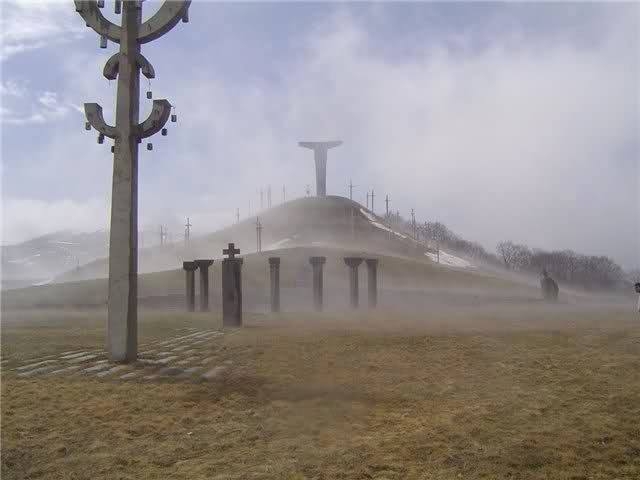
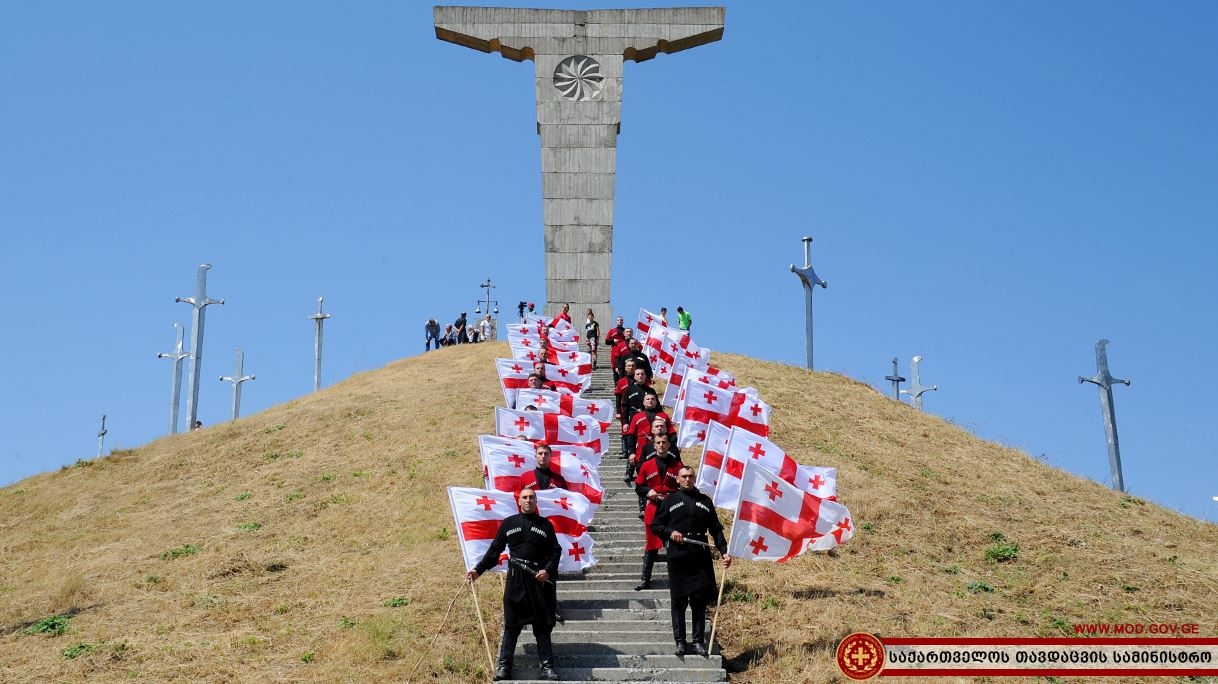
55,600 VS 200,000 250,000 or app 300,000Â Â Â
BEST BATTLE ! Hail Georgia
                                                   Â

A fresco of King David IV from Gelati Monastery.
Prelude
Najm ad-Din Ilghazi ibn Artuq
Both Georgian and Islamic sources testify that, on the complaints of the Muslim merchants of Tbilisi, Ganja, and Dmanisi, Sultan Mahmud II b. Muhammad of Baghdad (r. 1118-1131) sent an expedition into Georgia in which the Artuqid Ilghazi of Mardin; Tughan-Arslan, lord of Arzin, Bidlis, and Dvin; the Mazyadid Dubays II of Al Hillah and the sultan’s brother Toghrul ibn Muhammad; lord of Arran and Nakhichevan, with his atabeg Kun-toghdi all took part. The size of the Muslim army is still a matter of debate, with numbers ranging from a fantastic 600,000 men (as given by Walter the Chancellor and Matthew of Edessa) to 400,000 (Sempad Sparapets Chronicle), while estimates of modern Georgian historians vary between 100,000 and 250,000 men. Although the higher numbers are exaggerated, all sources in-dicate that the Muslims made massive preparations and vastly outnumbered the Georgians. This combined army under the overall command of Ilghazi, who had just won the Battle of Ager Sanguinis (1119), entered the valley of Trialeti in eastern Georgia and encamped in the vicinities of Didgori and Manglisi in mid-August 1121.
In mid-summer 1121, the Muslim troops advanced along various routes, with part of them passing the provinces of Erzerum and Kars, while Sultan Toghrul ibn Muhammad moved through Ganja and Tughan-Arslan the Hunchback marched from Dvin. Entering Georgian territory, they proceeded by the Manglisi-Didgori Valley toward Tbilisi. On 10 August, the enormous Muslim army bivouacked on a vast field near Didgori, about a day’s march from Tbilisi.Little is known of Ilghazis exact battle plan or course of action and order of battle other than the commonly suggested deployment of large numbers of light missile troops, particularly archers and light cavalry in the vanguard to harass the enemy lines while the bulk of the army remained behind them in orderly battle formation. It is suggested that Ilghazis vanguard approached Davids army and reported back about a much smaller force than expected, which might have raised Ilghazis confidence enough to not expect any surprise. It is also claimed that the Seljuq light cavalry rode in front of the Georgians and started to shoot and taunt them which was received with little to no effect on their morale. There is no evidence of heavy cavalry present on Ilghazis side or any type of cavalry which could have matched the Georgian counterpart.
King David ordered his Kipchak light cavalry to keep pursuing the retreating Seljuqs to prevent further conflict. The numbers of men fleeing the field must have been so huge that the Georgian cavalry was taking large numbers of prisoners for several days. As a result, the Georgians were able to liberate the entire region from Muslim influence and even contest territories within the Seljuq Empire, which at that point was left almost defenceless.
                                                          Strength
Seljuqs :Â Â Â Â Â Â Â
other sources: around 200,000-250,000 or app. 300.000.
contemporary chronicles: 400,000-600,000 or 800,000Â
Georgians:
40,000 Georgian troops Incl. 5.000 royal knights
15,000 Cumans-Kipchaks
500 Alan Mercenaries
100-500 Frankish Knights
Armenian and Shirvanese allies
55,600 VS 200,000 250,000 or app 300,000Â Â Â
BEST BATTLE ! Hail Georgia
Support
The Night KingThe Night KingThe Night Kinglonely wolfThe wolfGaladraelComments (2)

06 May 18 13:42
FeboBattle of Manzikert 1071 - Byzantine - Seljuq Wars or how it all started : https://www.youtube.com/watch?v=rn85RHrShrI

 Facebook
 Instagram
 Discord
 Reddit